Ask most Canadian mortgage brokers what their book of business is worth and you’ll get a blank look. They might tell you how many clients they have. They might tell you their annual production volume. They probably can’t tell you their retention rate, their repeat client rate, or how many dollars of future opportunity their book currently represents.
That’s a problem, because the book is the single most valuable asset most brokers own. A strong book produces deals year after year without new acquisition costs. A neglected book produces almost nothing, no matter how many new leads the broker chases.
This post is how to think about your book as an asset. The metrics that matter, how to benchmark them, and the operational practices that turn a contact list into a performing book. Written for established Canadian brokers with 100+ clients; the mechanics are similar for larger brokerages at team scale.
Why the book is an asset
The mortgage broker business has a structural economic quirk that makes past clients uniquely valuable. Acquiring a new mortgage client costs something - time, marketing, referral fees, opportunity cost - typically measured in the thousands of dollars per client. Retaining a past client through renewal or getting them to come back for a HELOC or refinance costs almost nothing by comparison.
Every past client is an asset that produces future revenue if you maintain it. The asset value is roughly:
Book asset value ≈ (average deal size × commission rate × repeat rate × average number of repeat transactions over the remaining broker relationship)
For a typical Canadian broker with an established book, this works out to several thousand dollars of expected future revenue per client. Across a book of 300 clients, that’s $750,000 to $1.5 million of embedded value - before you sell the book to another broker or get a new deal from any of them.
$1M+
typical embedded future revenue in an established Canadian broker's book of 300 clients. Treated as an asset, it compounds; treated as a contact list, it decays.
The brokers who treat this asset well produce consistent revenue with relatively low acquisition costs. The brokers who neglect it run on a treadmill of new lead acquisition, which is expensive and uncertain.
The metrics that matter
Five metrics describe the health of a mortgage broker’s book. Track them. Benchmark them. Improve them.
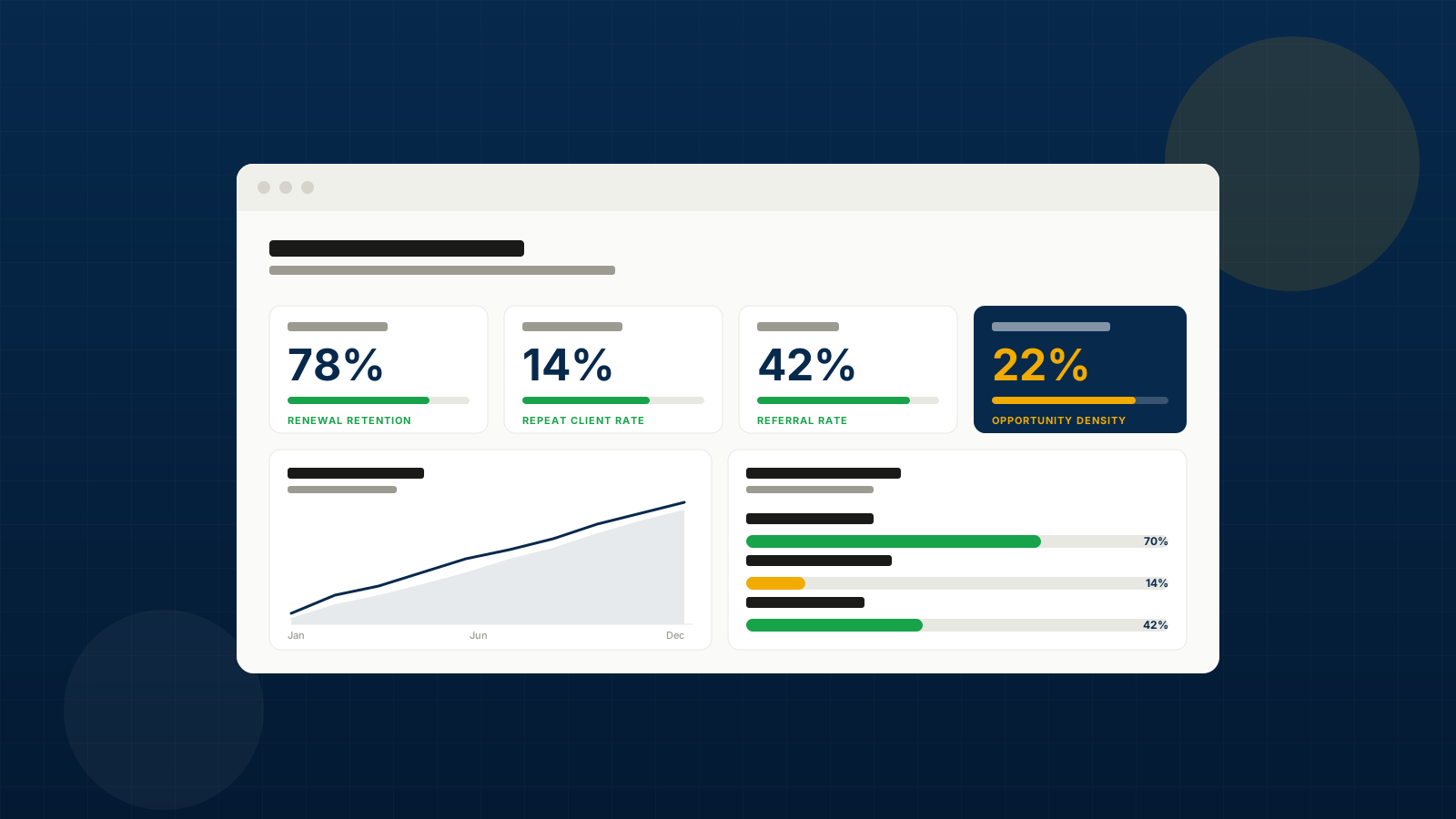
Renewal retention rate
Percentage of renewals you keep. The single cleanest measure of book health.
Renewal retention = (Renewals you funded) ÷ (Renewals that came due in the period)
The denominator matters - count every maturity that came due, not just the ones you tried to capture.
Benchmarks:
- 70 percent+ is strong. You’re actively managing renewals and winning most of them.
- 55-70 percent is average. You’re not losing dramatically but there’s room to improve.
- Under 55 percent is a problem. Either you’re not working renewals systematically, or something about your service is pushing clients back to the bank.
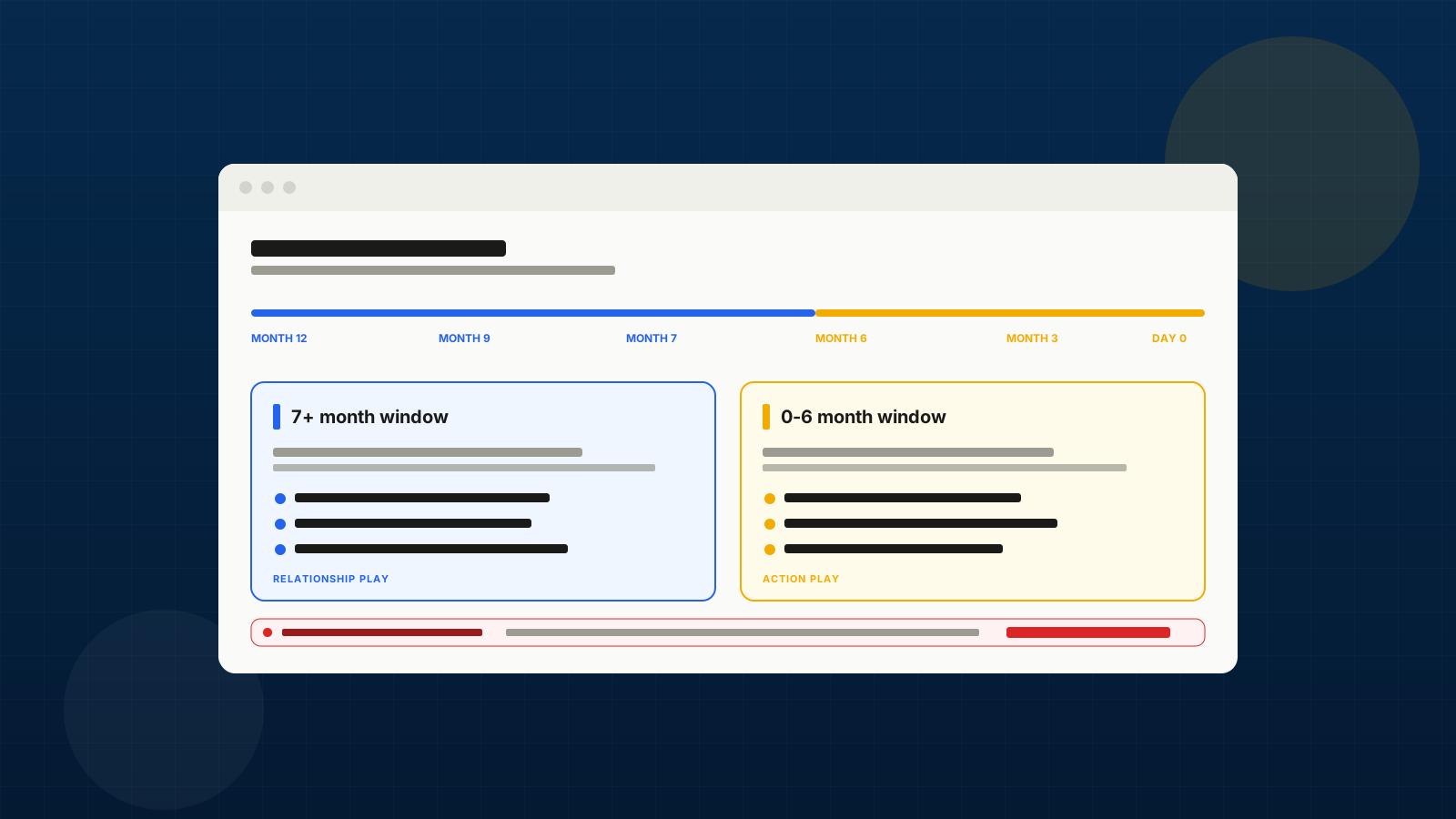
Renewal retention is the easiest metric to improve because the playbook is known (the two-window renewal tracking system from our renewal tracking post). Brokers who focus here see 15-20 percentage point improvements within 12 months.
Repeat client rate
Percentage of clients who come back for a second or subsequent mortgage transaction. Different from renewals - this covers refinances, new home purchases, investment property purchases, and any fresh transaction.
Repeat client rate = (Clients who transacted again in the period) ÷ (Total past clients in the book)
Benchmarks:
- 12 percent+ annually is strong. You’re actively generating repeat business.
- 6-12 percent is average.
- Under 6 percent suggests your book is effectively frozen - clients aren’t coming back because you’re not giving them reason to.
Ownwell reports their top broker users convert 10 percent of past clients into new business annually. That’s a reasonable north star.
Referral rate
Percentage of new clients who came through a referral from a past or current client.
Referral rate = (New clients from past-client referrals) ÷ (Total new clients in the period)
Benchmarks:
- 40 percent+ is strong. Your past clients actively recommend you.
- 20-40 percent is average.
- Under 20 percent means your business is dependent on lead generation channels, which is expensive and volatile.
Referral rate is a lagging indicator of service quality. If it’s low and stays low, the problem is usually the experience you deliver rather than the efforts you make to ask for referrals.
Opportunity density
Percentage of your book with at least one actionable opportunity (refinance, renewal, HELOC, reverse mortgage, or debt consolidation) at any given time.
Opportunity density = (Clients with actionable opportunity) ÷ (Total clients in the book)
Benchmarks:
- 20 percent+ is strong. Your book is actively producing findable opportunities.
- 10-20 percent is average.
- Under 10 percent often indicates stale data rather than a stale book - if you can’t see opportunities, you probably haven’t run a current analysis on fresh property values and balances.
Opportunity density requires a revenue intelligence scan to measure accurately. Manual calculation at book scale isn’t practical.
Data freshness
Not a performance metric but an enabler. Percentage of clients in the book with current data - current contact information, current home value estimate, current mortgage balance, current known debt levels.
Data freshness = (Clients with updated key fields in the past 12 months) ÷ (Total clients)
Benchmarks:
- 70 percent+ is strong.
- 40-70 percent is average.
- Under 40 percent means your book metrics are unreliable because the underlying data is stale.
Interactive client reports (which BrokerPlus and Ownwell both use) update data through client engagement rather than requiring broker effort. This is the operational lever for data freshness.
The typical book’s deficiencies
Canadian mortgage brokers, in aggregate, score lower than they should on all five metrics. The consistent deficiencies:
Renewal retention in the 45-60 percent range. Most brokers lose renewals because they don’t touch the client until month 3 or later, which is after the bank’s retention sequence has already fired.
Repeat client rate below 8 percent. Most brokers have no systematic way of identifying when a past client becomes a candidate for a refinance, HELOC, or other fresh transaction.
Referral rate below 25 percent. Brokers don’t ask for referrals systematically and don’t stay present enough with past clients for the client to think to refer.
Opportunity density appears low because the data is stale. The opportunities exist; the broker can’t see them because home values are based on 2020 data and balances are rough estimates.
Data freshness below 30 percent. Databases haven’t been updated since the client’s original transaction. No AVM in the stack, no interactive client reports pulling updated information.
The brokers who measure these metrics and work on them systematically produce measurably better results than their competitors. Most brokers neither measure nor work on them, which is why the benchmarks are lower than they should be.
Operational practices for improving the book
Four practices that move the numbers:
Practice 1: The monthly book review
On the same day every month, pull the key metrics. Not to post them anywhere - to look at them. What changed? Which metric is moving the wrong direction? What’s driving it?
The monthly review takes 30 minutes. It produces the information that tells you whether your book is improving or decaying. Brokers who don’t do this are running blind.
Practice 2: Systematic maturity tracking
The monthly maturity email - every client with a renewal in the next 90 days gets reviewed. Track the status. Renewal initiated? Quote prepared? Client signed? Lost to the bank? Knowing this in real time lets you intervene before the renewal is lost.
Practice 3: Continuous opportunity scanning
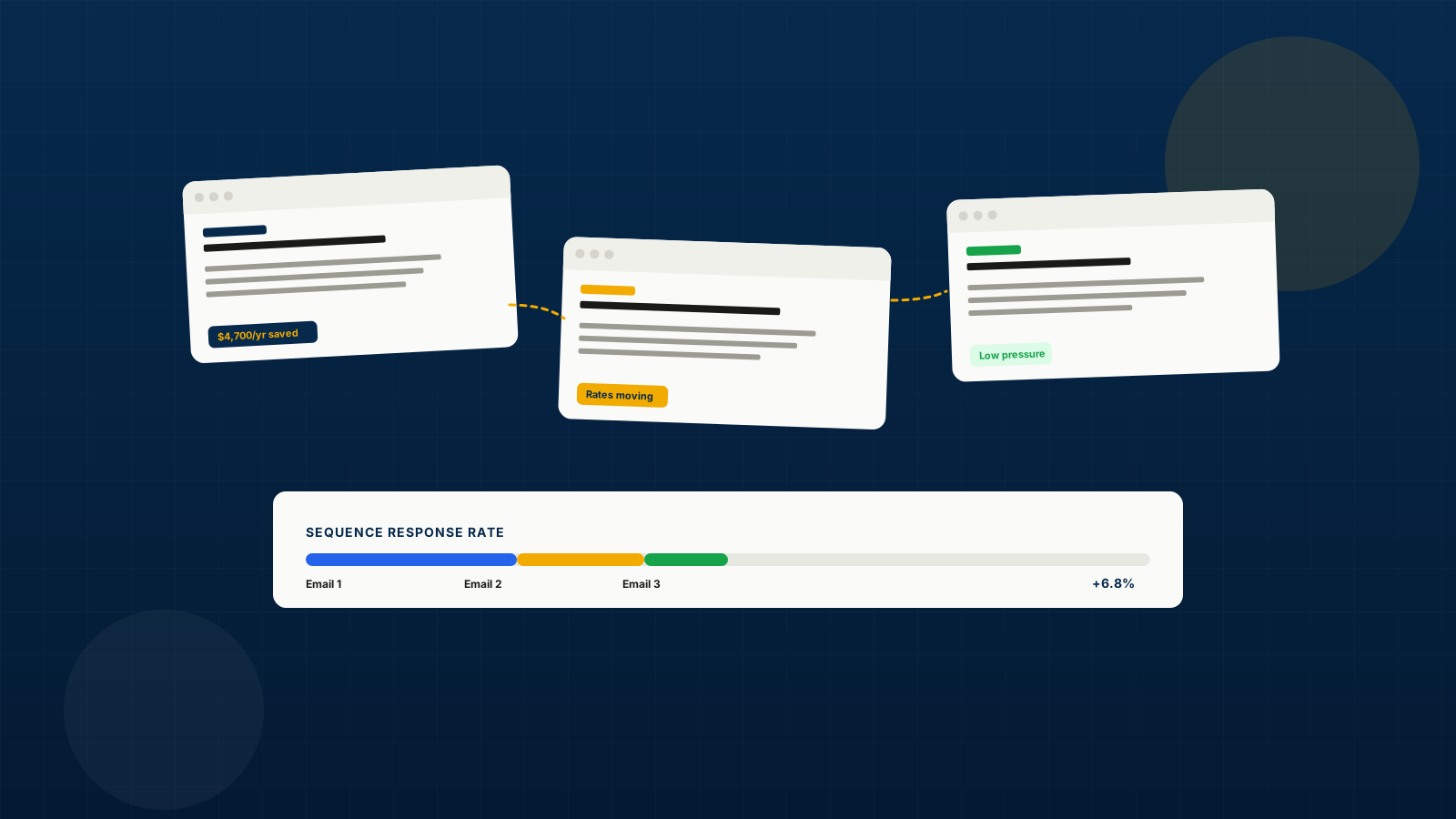
Run a revenue intelligence analysis on the book continuously or at least monthly. Surface new opportunities as they emerge (rates moved, home values updated, client debt changed). Act on the top candidates promptly - delay costs deals.
Practice 4: Data hygiene investments
Actively update client data. Use an AVM for property values. Use interactive client reports to update home values, mortgage balances, and debts through client interaction. Use Equifax or similar for credit file updates at appropriate intervals. Treat the database as the asset it is.
These four practices are what separate well-managed books from neglected ones. They’re not complex; they require consistency.
How software helps
The metrics that describe your book can be calculated manually if the data lives in a spreadsheet. For books over 100 clients, the calculation becomes impractical.
Modern broker platforms produce these metrics as first-class dashboard elements:
- BrokerPlus shows opportunity density as the primary view - every client ranked by opportunity type and dollar value, with data freshness indicators. Renewal windows split automatically into the 0-6 and 7+ month buckets. Interactive reports update client data without broker effort.
- BluMortgage tracks renewal rate and repeat client rate through its CRM reporting.
- Ownwell surfaces opportunity engagement and reports client-level interaction with monthly homeowner reports.
The right combination depends on your stack. What matters is that the metrics are visible and current rather than calculated twice a year when someone remembers.
Frequently asked questions
At what book size do I need to start thinking about this formally?
Around 100 clients. Below that, the book is small enough that you know every client by name and can manage relationships informally. Above that, you need systems. The transition from informal to systematic usually happens between 75 and 150 clients, depending on how organized the broker is naturally.
Which metric should I improve first?
Start with renewal retention. It’s the easiest to improve, has the clearest playbook (the two-window system), and has direct revenue impact within 6-12 months. Repeat client rate usually improves alongside renewal retention because the operational practices overlap.
Is there a way to put a dollar value on my book?
Roughly. Multiply the number of past clients by your average commission per client, by your expected repeat rate, by the average number of repeat transactions over the remaining relationship horizon. For a Canadian broker with 300 clients, average commission of $3,500, 10 percent annual repeat rate, and a 10-year relationship horizon, that’s roughly $1 million of expected future revenue. The specific number depends heavily on your inputs.
What about brokers who serve investor clients vs. owner-occupied?
The metrics apply the same way but the benchmarks shift. Investor clients tend to have higher transaction frequency (multiple purchases over time) and lower retention on any individual deal (they shop aggressively for rates). Owner-occupied clients have lower frequency and higher retention. Benchmark against your peer group, not a cross-segment average.
How do I measure referral rate accurately?
Ask every new client how they found you, and record the answer in a consistent field. Over time, the referral-sourced clients become countable. Don’t rely on memory or inference - if you’re not tracking this field for every new client, you can’t measure referral rate reliably.
What’s the relationship between opportunity density and repeat client rate?
Opportunity density is the supply; repeat client rate is the conversion. You can have high opportunity density (many clients with actionable opportunities) and low repeat client rate (not converting the opportunities into deals). That gap is usually the outreach layer - you’re finding the opportunities but not systematically acting on them.
How do I handle clients I haven’t spoken to in 5+ years?
They’re still in the book but their data is stale and the relationship is cold. Run the opportunity scan on them anyway - some will surface as actionable. For those that do, reintroduce yourself rather than assuming continuity. For the rest, consider a reactivation campaign: an outreach sequence designed to re-establish contact without leading with a sales pitch.